
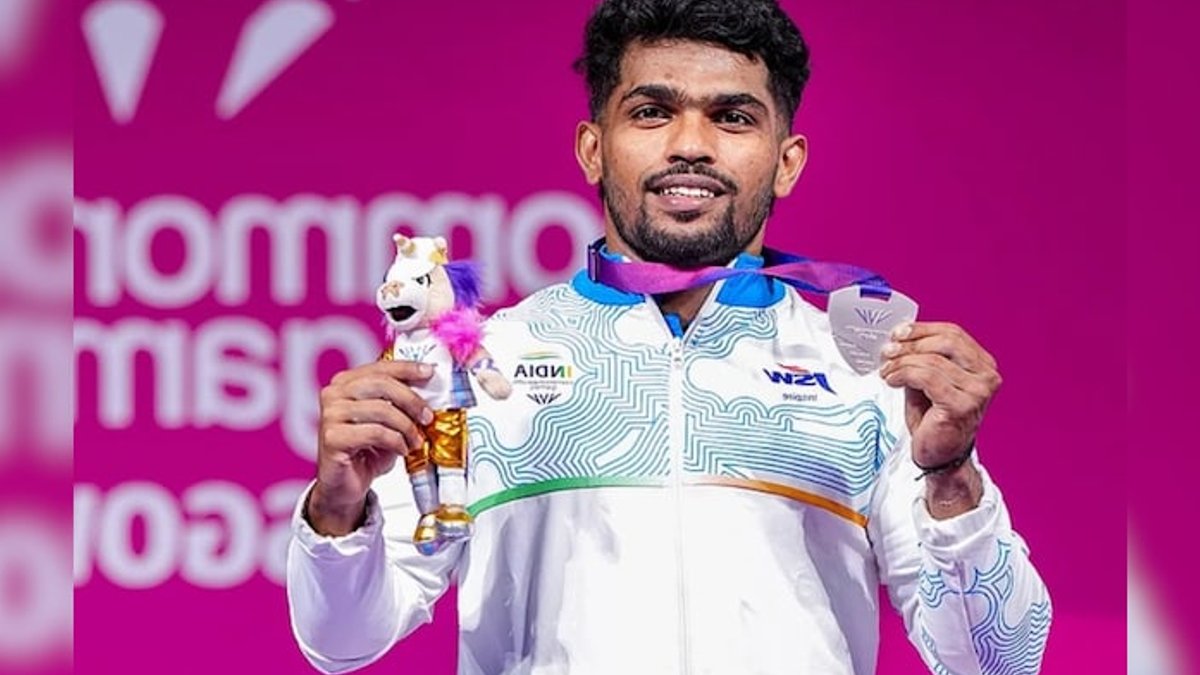
Indian weightlifter Raja Muthupandi secured a silver medal in the men’s 65kg category at the Commonwealth Games 2026 in Glasgow on Sunday, extending India’s strong performance in the sport. The 24-year-old athlete, competing in his second major international event, delivered a performance that showed both his technical precision and mental fortitude. His medal marked the fourth consecutive Commonwealth Games where an Indian lifter stood on the podium in this weight class, a streak that began in 2014 when K. Sanjita Chanu won gold in Glasgow’s predecessor edition. Muthupandi’s achievement also reinforced India’s dominance in weightlifting at the Games, where the country has consistently outperformed traditional powerhouses like England and Australia in recent years.
Muthupandi, who hails from Tamil Nadu’s Thoothukudi district, finished with a combined total of 286kg—126kg in the snatch and 160kg in the clean and jerk. Malaysia’s Aznil Bidin took gold with a Games record of 299kg, while Muthupandi’s lift earned him second place. The margin of 13kg between the two athletes reflected Bidin’s dominance in the event, though Muthupandi’s consistency across both disciplines kept him ahead of Nigeria’s third-place finisher, who trailed by an additional 5kg. The 65kg category, reintroduced to the Commonwealth Games program in 2022 after a decade-long absence, has become a fiercely competitive division, with lifters from Southeast Asia and the Indian subcontinent frequently setting new benchmarks. Muthupandi’s total, while below his personal best of 292kg set at the 2025 National Championships, was sufficient to secure his first international medal at the senior level.
Resilience Under Pressure
The 24-year-old lifter nearly missed his opening snatch attempt at 126kg, failing on the first try before successfully clearing it on his second. His final attempt at 129kg fell short, leaving him without the opportunity to improve his standing in the first half of the competition. In the clean and jerk, he rebounded from an unsuccessful 158kg lift to secure 160kg on his second attempt, locking in the silver. The sequence of near-misses and recoveries highlighted Muthupandi’s ability to compartmentalize setbacks—a trait that has defined his career since his junior days. His coach, S. Kannan, later noted that the lifter’s composure under pressure was honed during grueling training sessions in Thoothukudi, where power outages and limited equipment forced athletes to adapt to unpredictable conditions. The clean and jerk, often considered the more technical of the two lifts, saw Muthupandi employ a split-second adjustment to his foot positioning during his second attempt, a correction that allowed him to stabilize the weight overhead.
His performance drew praise from political leaders. Prime Minister Narendra Modi congratulated Muthupandi on social media, calling the medal “another achievement for India in weightlifting” and expressing pride in his success. “His success makes every Indian happy and proud,” Modi wrote in a post on X. The Prime Minister’s acknowledgment came amid a broader trend of increased government recognition for Indian athletes, particularly in disciplines where the country has historically underperformed. Modi’s post, which included a photograph of Muthupandi mid-lift, was shared over 12,000 times within hours, reflecting the growing digital engagement with India’s sporting successes. The post also tagged the Indian Weightlifting Federation, urging continued support for the sport’s development.
Related: Stock Market Update For July 27
State Recognition and National Momentum
Tamil Nadu Chief Minister C. Joseph Vijay announced a cash reward of Rs. 30 lakh for Muthupandi, calling his victory a “proud moment for Tamil Nadu and the nation.” In a statement, Vijay said the award recognized Muthupandi’s perseverance and hoped it would inspire young athletes across the state. The reward, equivalent to approximately $36,000, was part of a broader state policy to incentivize sporting achievements, with previous recipients including table tennis player Sharath Kamal and sprinter Dutee Chand. Vijay’s statement was released in both English and Tamil, with the latter version emphasizing the cultural significance of Muthupandi’s roots in Thoothukudi, a coastal district known more for its fishing industry than its athletic pedigree. The Chief Minister’s office also confirmed that the state government would explore avenues to provide Muthupandi with long-term support, including potential employment opportunities in the public sector—a common practice for medal-winning athletes in Tamil Nadu.
The win marked India’s second weightlifting medal of the day at CWG 2026. Earlier, Rishikanta Singh Chanambam had won silver in the men’s 60kg category with a personal-best performance. Chanambam, a 22-year-old from Manipur, lifted a combined 278kg to finish behind England’s reigning world champion, who set a new Games record. Mirabai Chanu also added to India’s tally by securing her third consecutive Commonwealth Games gold in the women’s 48kg event. Chanu’s victory, achieved with a total of 196kg, was particularly notable as it came just eight months after a career-threatening wrist injury. Her ability to reclaim the top spot in Glasgow, despite limited competitive exposure in the preceding year, was widely regarded as a sign to her resilience and the depth of India’s weightlifting program. The trio of medals on a single day raised India’s overall tally to seven, placing the country third in the standings behind Australia and England.
Muthupandi’s achievement continues a pattern of Tamil Nadu producing elite weightlifters, though the state’s sports infrastructure has often lagged behind its talent pool. His success, like others before him, has relied more on individual grit than institutional support—a reality that occasionally sparks debate about how much more could be achieved with better funding and training facilities. Tamil Nadu’s weightlifting tradition dates back to the 1980s, when athletes like S. Muthuswamy and N. Kunjarani Devi dominated national competitions. However, the state’s training centers, particularly in rural areas, have struggled with outdated equipment and a lack of specialized coaching. Muthupandi’s early training took place in a makeshift gym in Thoothukudi, where he and his peers often shared a single barbell and relied on homemade weights fashioned from concrete and scrap metal. Despite these challenges, the state has produced a disproportionate number of international medalists, a phenomenon often attributed to the region’s strong work ethic and the influence of local sports clubs that operate independently of government support.
For now, the focus remains on the podium. Muthupandi’s silver adds to India’s growing medal count in Glasgow, where the country has already surpassed its performance from the previous Games. With more events still to come, the weightlifting contingent remains a strong contender for further success. The Indian team, which includes 14 lifters across seven weight categories, is targeting a top-three finish in the sport’s overall standings. Muthupandi’s medal, combined with Chanambam’s and Chanu’s, has positioned India as a serious threat in the men’s and women’s divisions, with upcoming events in the 73kg and 81kg categories expected to yield additional podium finishes. The Games’ weightlifting program, which concludes on August 2, will also feature a mixed-team event for the first time, offering another opportunity for India to expand its medal haul.


