


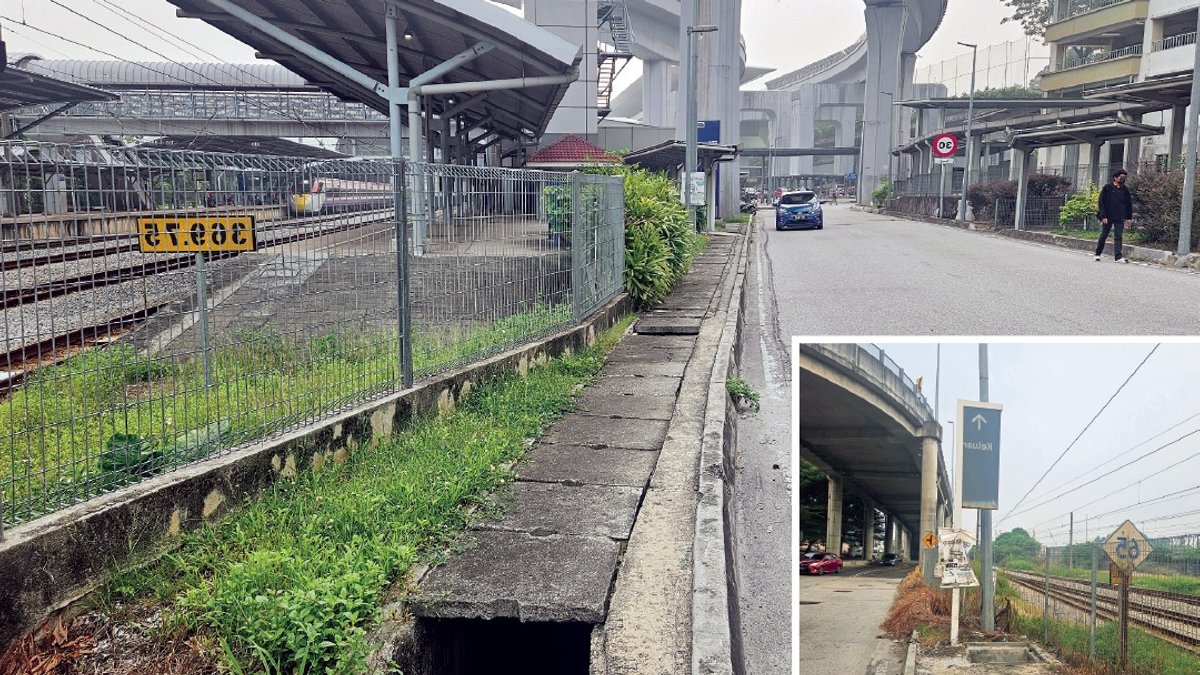
Malaysia’s train stations have a significant walkability gap, with many commuters facing difficulties when walking to their destinations. The LRT Shah Alam line, which started operating four months ago, has highlighted this issue, with commuters taking to social media to express their frustrations.
The problem lies in the lack of pedestrian infrastructure, including missing pavements, overgrown tree roots on sidewalks, and uncovered drainage on pathways. Many stations are technically within walking distance of nearby developments, but the routes often lack walkway infrastructure.
Town planners Julie Chok and Fathuddin Kamaruddin attribute this issue to the country’s historical focus on automotive policy, rather than walking and cycling. Chok notes that cities in the Klang Valley introduced rail-based public transit as an afterthought, resulting in fragmented and disconnected networks.
Chok explains that most stations came with covered walkways and crossings to adjacent bus stops, but the extension of connections within the transit catchment is often left to local authorities and private sector developers. This can lead to a blame game between parties, as seen when the LRT Shah Alam line stations opened.
Fathuddin emphasizes that pedestrian walkways should be in place from the beginning, rather than being added later as an afterthought. He suggests that local city councils need to have a mechanism in place to ensure that walkway infrastructure is properly planned and implemented.
Chok agrees, stating that pedestrian permeability and connectivity can be achieved through a combination of at-grade walkways, building-to-building connections, linkways, and underpasses. She highlights the importance of local authorities playing a critical role in coordinating these connections across private and public land.
Improving Pedestrian Access
Despite these challenges, some local city councils have begun improving pedestrian access to public transport stations. The Shah Alam City Council has approved a network of covered and uncovered walkways to link several LRT stations to their surrounding areas.
Read Also: Indonesian rupiah hits record low amid investor concerns
The Subang Jaya City Council has also started several pedestrian walkway projects, including a new walkway along Persiaran Subang Permai to improve access to the USJ 7 LRT station. Additionally, the Petaling Jaya City Council has launched a RM1 million Safer School Streets pilot to improve pedestrian infrastructure around schools.
As for existing developments and older train stations, Chok suggests that local city councils and developers can explore the use of air-space provisions to help overcome land constraints. This could include raised or cantilevered walkways above drains, canals, stations, and railway tracks.
Key Features of Walkability
Fathuddin notes that good pedestrian infrastructure should have three main aspects: continuity and accessibility, safety features, and comfort. He cites Singapore as a relevant example of walkable urban design for Malaysia, particularly in addressing thermal comfort within a tropical climate.
Chok adds that the typical arrangement for MRT and LRT stations is establishing covered walkways from the station to adjacent bus stops and park and ride facilities. Some existing developments have built pedestrian bridges connected to the stations, such as the Bandar Utama MRT station to 1Utama.
Commuters who encounter terrible walkways can file complaints to local authorities or share their experiences with fellow commuters. Once these issues become widely visible, there can be an increase in awareness and action, potentially leading to changes in pedestrian infrastructure.
According to Fathuddin, local authorities can provide incentives, such as reducing statutory contributions or offering development incentives, to encourage developers to design and construct better walkways as part of their development projects. Maintenance can also be addressed through public-private partnerships, such as Adopt-a-Park programmes.


