


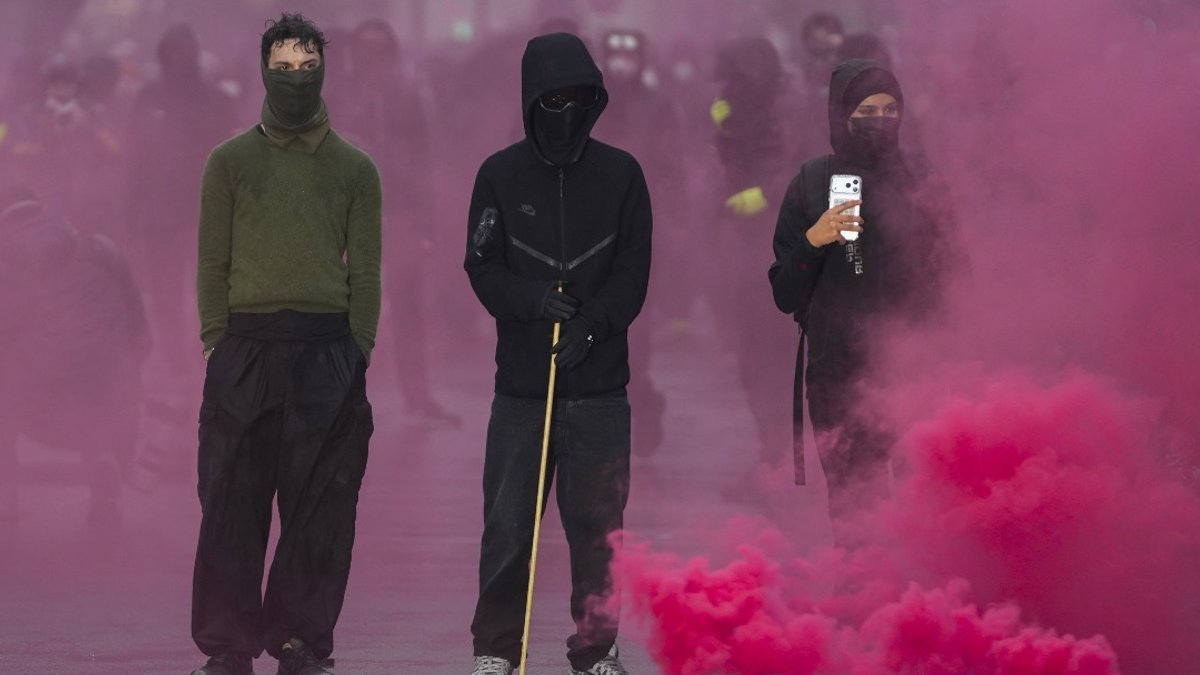
110,000 people took part in Saturday’s Paris demonstration, while an additional 300,000 joined protests across France. The Interior Ministry confirmed that while most gatherings proceeded without major incidents, confrontations occurred at the edges, particularly when masked demonstrators in black faced off against security personnel. Police deployed tear gas and water cannons, but the damage stayed minimal, contrasting sharply with the Oct. 17 unrest, which saw widespread looting and arson in cities nationwide. France avoided a repeat of large-scale violence and looting on Oct. 25, reinforcing the view that the government’s preemptive security measures had succeeded in containing the protests.
Interior Minister Laurent Nunez attributed the reduced violence to an intensified security operation, with 70,000 officers mobilized across the country. Military units secured key buildings, armored vehicles patrolled streets, and helicopters maintained aerial surveillance. Some municipalities imposed curfews, banned protests outright, and shuttered landmarks like the Louvre, while a major football match in Paris was postponed. Nunez explicitly warned that the clashes were orchestrated by the ultra-left, which he described as seeking to “start and finish the uprising,” signaling a deliberate strategy to escalate tensions.
Read Also: Trump lifts tariffs on Canadian goods ahead of Maine election
The government’s delayed response to last week’s chaos had been a point of criticism. President Emmanuel Macron acknowledged in a recent address that authorities had been unprepared when demonstrations spiraled into riots, with attackers targeting public infrastructure and engaging in direct clashes with police. This time, preemptive measures included restricting public movement, reinforcing storefronts, and positioning elite anti-terror units to prevent a repeat of the earlier disorder. Macron’s admission of “planning failings and elements of surprise” showed the government’s shift from reactive to proactive policing.
Student demands drive ongoing protests
The protests originated in September, when student groups organized walkouts to demand increased teacher hiring, school repairs, and reforms to Parcoursup, France’s online college admissions platform. Nathanaël Combary, spokesperson for the Renouveau Lycéen union, stated that students would continue demonstrations unless the government delivered on promises. “The period of dialogue has lasted long enough,” he told Sunday newspaper La Tribune Dimanche. “We now expect action.” The union’s leadership is scheduled to meet with Prime Minister Sébastien Lecornu on Monday, further escalating pressure for concrete action.
Labor unions have scheduled a nationwide strike for Nov. 5, with the CGT declaring it would maintain pressure until its demands were satisfied. The union’s public statement emphasized: “The anger is immense, and our determination is even greater.” The CGT estimated total protest turnout at 800,000, far surpassing official figures, reflecting deep public dissatisfaction with the government’s handling of the crisis.
Read Also: KLCC luxury market expands beyond expatriate buyers
Unrest reshapes France’s political and economy
An Ipsos-BVA-Cési poll released Saturday placed far-left candidate Jean-Luc Mélenchon in second place, trailing only far-right leader Marine Le Pen. The poll of 1,500 adults, conducted online on Oct. 21 and Oct. 22, highlighted how the unrest has reshaped political trends ahead of next year’s presidential race. Mélenchon has leveraged the protests to criticize police tactics and push for concessions from Macron, while rivals accuse him of exacerbating tensions. Meanwhile, the protests introduce new challenges to France’s economic stability. Moody’s Ratings chose not to downgrade France’s credit rating on Friday, but cautioned that the unrest could complicate efforts to cut debt, which is already under strain from sluggish economic performance.
Preliminary third-quarter GDP figures, set for release on Friday, are projected to show growth of just 0.1%, following stagnation in the prior quarter. The economic slowdown intensifies pressure on a government already dealing with social unrest and climbing bond yields, now approaching levels last observed during the eurozone debt crisis.


